The Huangze Temple lies in the west bank of the West Jialing River in Guangyuan City, Sichuan Province, east side of Wulong Mountain, and is separated from Guangyuan City by the river.
 |
|
The Huangze Temple, originally called the Wunu Temple, has another name Chuanzhu Temple. It is said that the temple was built to memorize Li Bing and Er Lang. In the Zhenguan reign of the Tang Dynasty (618-907), when Wu Shihuo, Wu Zetian's father, was in charge of Lizhou County, Wu Zetian, who later became the only empress in Chinese history, was born here. Then, the Chuanzhu Temple was renamed Huangze Temple. The extant Huangze Temple was repaired in the Qing Dynasty (1644-1911). It was built according to the physical features of the mountain, which is uneven and irregular. With green trees and red attics, cinnabar railings and painted pillars, it looks simple and elegant, but in fact it is out of the ordinary. The Big Buddha Building is at the highest place of the temple, while the Zetian Hall is the most low-lying. There are other structures such as the Small South Sea, the Viewing River Pavilion, the Five-Buddha Pavilion, and the L
üzu Hall, etc.
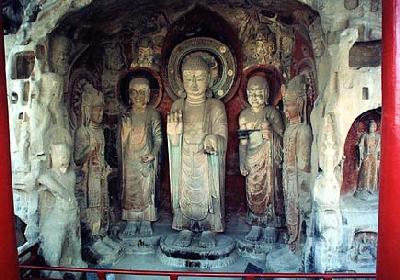
The statues and engravings on the Cliff of the Huangze Temple are behind the temple, carved in the cliff against the river. There are more than one thousand statues, from the Southern and Northern Dynasties (386-581) to the Song (960-1279) and Ming (1644-1911) dynasties, mainly including the Central Pillar Grotto, the Big Buddha Grotto, the Shrine of Five-Buddha Pavilion, the Shrine of Zetian Palace, and so on. The Central Pillar Grotto, also called the Zhitishi Grotto, is square, and the lines between its four angles join at the central pillar. Shrines are chiselled in the three walls of the grotto, decorated with the Thousand-Buddha images. The sculptures on the pillars and Thousand-Buddha statues on the three walls, with simple and clear outline, reflect the characteristics of stone carvings in the Southern and Northern Dynasties. There are a Buddha, two disciples and two Bodhisattvas in the shrines of the three walls, with full and round faces and bold and vigorous dispositions. The upper shrine houses crouching dragons and flying goddesses.
Up the stares along the cliff, people can reach the Big Buddha Building. The Big Buddha statue in it, carved on the wall of the cliff, is the biggest giant stone statue here. The Big Buddha's body is stalwart, and inclines forward a little with a serene looking. The left, right and front sides of the statue keep the arc plane. The two disciples and two Bodhisattvas standing at both sides are smoothly carved. The statues standing besides the Buddha, such as the Heavenly King, Buddha's warrior attendants, the Hercules and so on, are well arranged and seem bold and powerful. Sculptures namedDemi Gods Semi Devilswere carved in the back wall behind the Big Buddha. At the foot of the Buddha, there stands a provider kneeling on one knee. He is dressed in the uniform of the Tang Dynasty, and may be the official who offered donation to build the temple.
The Five-Buddha Pavilion was named after five shrines. Among them, the No. 1 grotto is the biggest. The main statue, Sakyamuni, whose body is moderate, wears a cassock over one of his shoulders. The folds of his clothes are thin and smooth. The Bodhisattvas besides the Buddha look pretty, with graceful figures, hair worn in buns. They wear jewel rings, fine hats and ornaments, and dress in fine gauzes and silk skirts, and look slim and graceful. These are the treasures of local statues. Besides, the pavilion is carved withthe Painting of Herding Cowsand dagobas. In the Writing Scriptures Cave of the temple, the inscriptions written by Yan Zhenqing, a famous writer of the Tang Dynasty, were preserved.
Besides the statues and engravings on the cliff, the Huangze Temple has other stone carvings. For instance, the inlaidPainting on Twelve Things of Silkworm, which is intaglioed in the wall, describes the vivid process of planting mulberry, raising silkworms and reeling silk in the Qing Dynasty in twelve pictures. They are both special carving artworks and precious materials.







 Email to Friends
 Print
Print Save
Save