The Dagoba in the Xingjao Temple is located in Shaoling to the east of Duqu in Chang'an County, Xi'an City, Shaanxi Province.
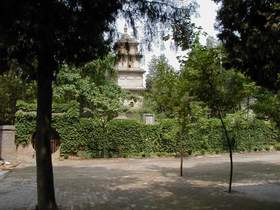 The Xingjao Temple was one of the eight temples in Fanchuan in the Tang Dynasty (618-907). In the 3rdof the Zhenguan reign in the early Tang Dynasty, Xuanzang went on a pilgrimage to India for Buddhist scriptures. It took him 17 years to come back. Xuanzang wrote books to expound the doctrines and therefore enjoyed a high reputation in India. In the 19thyear (645) of the Zhenguan reign, he went back to Chang'an with a lot of Buddhist sutras. According to the historical records, when Xuanzang was back to Chang'an he was received with great courtesy. At that time, numerous citizens went up to greet him and even Tang Emperor Taizong held a splendid ceremony to receive him personally. After that, Xuanzang devoted himself to the translation of Buddhist sutras in three famous places, namely the Hongfu Temple, Daci'en Temple, the Yuhua Hall. It took him 19 years to translate 74 sutras in 1,335 volumes in Sanskrit. Based on his traveling experiences, he also wrote books includingPilgrimage to India, which have a detailed recordation of the ancient histories and geographies in the Middle Asia, India and Pakistan and therefore are of great importance for research of the History of communications between the Middle and Western Asia. In the first year (664) of the Linde reign under Tang Emperor Gaozong, Xuanzang passed away and was buried in the White Deer Garden on the eastern bank of Chan River in the eastern suburbs of Xi'an. In the second year (669) of the Zongzang reign, his coffin was removed to the Xingjiao Temple, and a dagoba was also built, which is known as the Dagoba in Xingjao Temple.
This dagoba was built of bricks, and is 21 meters high. It is a huge square and five-storeyed dagoba. In the first floor, there is an arched door built of bricks in the south and a square room that enshrines the statue of Xuanzang; in the north is a stele recording the life story of Xuanzang. The hidden laid octagonal leaning pole and wooden square blocks inserted between the top of a column and a crossbeam are rare in other buildings and therefore the temple is a typical brick temple in the early Tang Dynasty.
On both sides of the dagoba of Xuanzang are the dagobas of his two disciples, Kuiji and Yuance (Korean), both of which have stone-carved epitaphs and clay sculptures.
In the temple, other than the dagoba, there are other buildings such as the Main Hall, the Depository of Buddhist Scriptures and so on built in the modern times.







 Email to Friends
 Print
Print Save
Save