 |
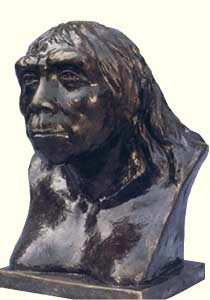
| Peking Man |
For thousands of years, questions regarding the origin of heaven, earth and man have puzzled people all over the world. In western countries, the Judaic tradition taught that "God created the heaven, earth and man in his own image." While inChina, myths such as that of Pangu creating the heaven and earth, and Nuwa creating man, are widely known to everyone. However, none of these stories gives us an irrefragable answer of how the earth came into being and how mankind appeared.
Fortunately, the development of science, especially modern archaeology, paleontology and geology, offer powerful insight to solving these mysteries.
In China, human fossils found in Wushan, Chongqing Country that are over 3 million years old are believed to be the remnants of the earliest human that lived in China. Also, large quantities of fossils were spread out over a number of other sites inChina. Known as Yuanmou Man, Lantian Man, Peking Man and Upper Cave Man (Shandingdong Man), such discoveries provide sufficient evidence to substantiate the claim thatChinawas one of man's birthplaces, as well as ancientAfrica.
Archaeological and paleontological research in recent decades has proven that the appearance of man was the result of evolution, while primates are considered his ancestors.
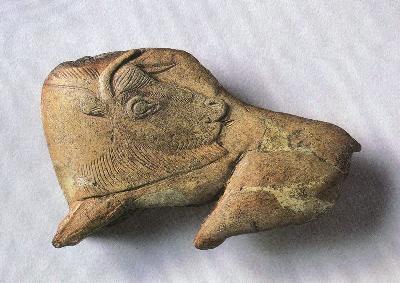 |
| Animal bone implement used by primitive people |
In the long process of evolution from primate to ancient man, labor played a significant role. Originally, the production tools made and used by man were made of coarsely chipped stone. To distinguish these from ground stone implements that man used later, archaeologists named the period where such chipped stone implements were made and used the Paleolithic Age (the Old Stone Age), and the age where ground stone implements were made and used the Neolithic Age (the New Stone Age).








 Email to Friends
 Print
Print Save
Save