 |
 |
 |
 |
 |
 |
|
|
|
|
|
|
| Travel in China > Protected Sites > Class Ⅰ > Sites |
|
|
||||
 E-Mail
This Article E-Mail
This Article  Print
Friendly Format Print
Friendly Format |
||||
|
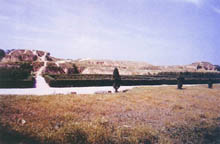
Daming Palace Site The Site of the Daming Palace is located on the Longshou Plateau in the north suburb of Xi'an City, Shaanxi Province.
With a perimeter of 7.6 kilometers, the Daming Palace had 11 gates. The main street, Danfengmen Street, was 176 meters wide. Over 40 sites of palaces and pavilions were unearthed at the site, mainly built around the Taiye Pool in the north of the palace. These sites included Hanyuan Hall, Linde Hall, Sanqing Hall, Qingsi Hall, Xuanzheng Hall and Zichen Hall.
The Hanyuan Hall was where emperors held ceremonies and met with officials. With a foundation of over 15 meters high, the hall was 75.9 meters long from east to west, and 41.3 meters wide from south to north. The hall, 11 rooms wide and 4 rooms deep, was the central hall of the Daming Palace, with each gate about 5.3 meters wide.
Built in the west of the Daming Palace was the Linde Hall where emperors met with foreign envoys. The hall covered an area of 12, 300 square meters. According to survey, the hall had three adjacent buildings constructed on a high base, with a pavilion built on each side of the middle one, and a building built on each side of the back one. Corridors surrounding the three buildings linked all sections together.
The Sanqing Hall was built in the northwest corner of the Daming Palace, with its base covering an area of 4000 square meters. On the base were originally pavilions. People in the Tang Dynasty worshiped Taoism and offered sacrifice to Laozi, and the Sanqing Hall was where members of imperial family made offerings to the Taoist figures.
The Qingsi Hall, built during the reign of Emperor Jingzong, was unearthed in the east part of the palace. The hall, with its base in a square shape, was 228 meters long from south to north, and 33 meters wide from east to west. About 300 meters right to the north of the Hanyuan Hall were sites of the Xuanzheng Hall and the Zichen Hall that were built on the same axis line as the Hanyuan Hall. The Xuanzheng Hall was the place where emperors met with the officials, and the Zichen Hall was the government office inside the imperial palace. That officials met with the emperor in the Zichen Hall was called entering the cabinet.
200 meters to the north of the Zichen Hall was the north brink of the Longshou Plateau, under which was the Taiye Pool (also known as the Penglai Pool). Taking an oval shape, the pool was 500 meters long from east to west, and 320 meters wide from south to north. An earth mound of 5 meters high protruded in the east of the pool and it was considered to be the site of the Penglai Hill. To the north of the Daming Palace was the imperial garden, where there were a number of buildings of various styles. These buildings were masterpieces of the garden constructions of the Tang Dynasty. |
||||
All rights reserved. Reproduction of text for non-commercial purposes is permitted provided that both the source and author are acknowledged and a notifying email is sent to us. |
||||
 |