 |
 |
 |
 |
 |
 |
|
|
|
|
|
|
| Travel in China > Natural Scenery > Scenic Mountains |
|
|
||||||
 E-Mail
This Article E-Mail
This Article  Print
Friendly Format Print
Friendly Format |
||||||
|
Maiji Mountain
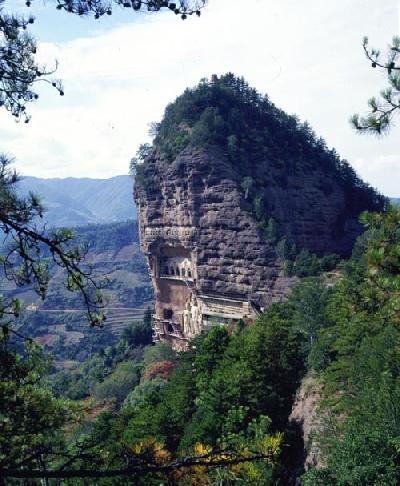
The landscape around Maiji Mountain is very beautiful, with green cypresses and pines, wild flowers and flourishing grass on the chain of mountains. After climbing up the mountaintop, you can see the shield-like peaks and the thousands of mountains and gullies when you look as far as you can. The pines look like the sea and the cloud and mist are slowly flying over the peaks. This scene is known as the Maiji Misty Rain, ranking first among the eight scenic spots in the Tianshui Region.
One of the remarkable characteristics of Maiji Mountain lies in that the locations of the grottoes are very breath-taking, as most of them are chiseled on cliffs and people can only access the grottoes through the overhanging plank roads among the grottoes.
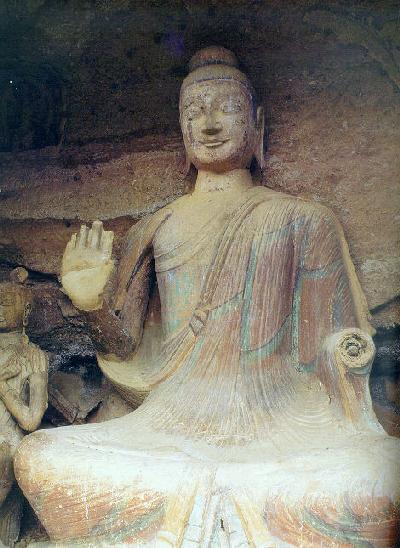
The art of the Maiji Grottoes, as reputed as the Grand Exhibition Hall of Statues, is famous in the world for its fine clay sculpture art. If the Dunhuang is a great hall of frescos, Maiji Mountain is a great hall of statues. Among the statutes here, the big ones can be up to more than 15 meters in height and the small ones are only 20 more centimeters in height. These statutes show the statue characters of various ages for more than 1,000 years and systematically reflect the development and evolution process of Chinese clay sculpture art. The clay sculptures here can be approximately divided into the following four types: (i) high-relief pieces extruding from the wall space, (ii) round carvings fully separated from the wall space, (iii) molding statutes pasted on the wall and (iv) wall carvings. Among them, thousands of human-size round carvings are full of life sentiment and are regarded as treasures accordingly.
The statutes of Maiji Mountain have two obvious characteristics: strong national consciousness and tendency of secularization. Except for the early works, almost all the statutes from the Northern Wei Dynasty (386-534) are in the postures bowing their heads with amiable faces. Though the statutes are the deities of the heaven, they look like the worldly persons and become the incarnations of persons' good wishes. In terms of the forms and dressings, these statutes gradually get rid of the impacts of exotic arts, showing the characteristics of the Han nationality.
Many grottoes of Maiji Mountain were built as Cliff Pavilions. The Qifo Pavilion (seven-Buddha pavilion) on steep precipice 15 meters above the Grand Clay Buddha statue on the eastern cliff is the typical cliff pavilion style of the Han Dynasty (206BC-220AD). It was first cut in the mid 6th century and is more than 50 meters above the ground. Though most statutes of the Maiji Grottoes are made of clay, a considerable number of the grottoes are the stone carvings and frescoes. The resort of the Maiji Grottoes is ranked as the cultural relics site under the national protection, and the overhanging plank road of 1,300 meters long is newly constructed and repaired, so tourists can easily visit all the grottoes. |
||||||
All rights reserved. Reproduction of text for non-commercial purposes is permitted provided that both the source and author are acknowledged and a notifying email is sent to us. |
||||||
 |