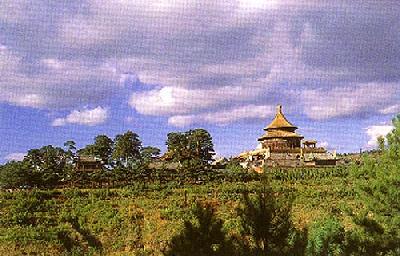
The Pule Temple is one of Eight Outer
Temples in Chengde City. The place, where the Pule Temple is located, used to be
a flat ground. People could see mountains around the Mountain Resort. Following
the advice of a Tibetan Living Buddha, Emperor Qianlong built the temple in
1766. The temple is made up of the front hall, side halls and the massacre city.
The front hall, called the Zongyin Hall, houses Buddha of Infinite Longevity and
other Trikala Buddhas with warrior attendants standing on both sides of each
Buddha. There is an altar in the back, with a height of 35.5 meters. It is
divided into 3 layers. The 1st and 2nd layers are square
stone platforms. There are 3 rooms in the 1st layer and 72 hallways
around it. There are 4 doors in four different directions in the 2nd
layer. There are 8 Lama pagodas in four corners and four directions. The pagodas
in the four corners are yellow and four pagodas in four directions are black,
green, purple and white, respectively. The stone fences around the
3rd layer are carved with dragon-and-cloud patterns. The Xuguang
Pavilion in the middle of the 3rd layer is 23 meters high with a
diameter of 21.68 meters. The multi-eaved roof is covered with glazed tiles,
similar with that of the Hall of Prayer for Good Harvest in the Heaven Temple,
Beijing. The sunk panel of 4 layers in the hall is extremely exquisite. There
are inner and outer circles in the 1st and 2nd layers.
Pictures of 6-character incantation are carved on the outer circle of the 1st
layer and a gilding cloud pattern made of wood appears in the inner circle. A
gilding dragon pattern appears in the outer circle of the 2nd layer,
and a gilding peacock pattern appears on the inner circle. Lotus pattern is
carved on the 3rd layer. A huge dragon with tremendous momentum,
looking down, pearl in its mouth and clouds around it appears in the
4th layer. The sunk panel in the Xuguang Pavilion is one of the most
exquisite sunk panels of the Ming Dynasty (1368-1644) and the Qing Dynasty
(1644-1911).
No Lamaists live in the temple at peacetime.
Lamaists from other temples will get together to chant scriptures on the
1st and 15th of the first lunar month.




 E-Mail
This Article
E-Mail
This Article  Print
Friendly Format
Print
Friendly Format