Gate Blocks: Beauty in the Details
One of the coolest features of Chinese old-styled courtyards are the gate
blocks, known as mendun'r in Chinese. Architecturally, gate blocks are
the stone mounts that secure the wooden doorframes to residence walls. The
baseboards between the gate blocks force people to step over it - and also keep
out evil spirits or disease.
Gate blocks were created in two shapes: round
ones somewhat like drums, and rectangular ones, both of which were carved with
exquisite pattern designs. An important part of courtyard houses, the gate
blocks were also kind of elegant stone craftworks.
It is hard to pinpoint exactly when mendun'r first appeared.
According to historical records, menzhen (blocks of stone used at the base of
door shafts) appeared in courtyard houses as early as the Han
Dynasty. The gate blocks might have gradually evolved from these stone
blocks. In fact, carvings appeared on the outside part of menzhen a long time
ago. For example, the menzhen of the stone gate to the Empress Wencheng's
Mausoleum of the Northern
Wei Dynasty (452-465) was made in the shape of a tiger
's head.
 Gate Blocks' origin and
evolvement Gate Blocks' origin and
evolvement
Carved Menzhen Stones
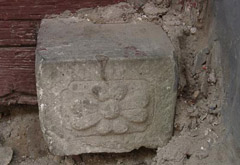
Since the outdoor part of a menzhen stone was visible to every passerby, it
was natural for people to decorate it. Then one day, a man carved some
decorative lines on it, as is recorded in a historical book. This was believed
to be the predecessor of formal gate blocks that we can see today.
|




 E-Mail
This Article
E-Mail
This Article  Print
Friendly Format
Print
Friendly Format