|
Zoomorphic Ornaments: Detailed Representation of Chinese Culture
 Ancient Chinese palace and landscape architectures, with a
long history, are highly accomplished and uniquely styled in terms of planning,
architectural complex, space, and even ornaments. Of all the Chinese palaces, temples,
and mansions, the most magnificent and beautiful part is the roof,
which boasts the most conspicuous difference from Western buildings and which
has won the most praise for Chinese
architecture. Ancient Chinese palace and landscape architectures, with a
long history, are highly accomplished and uniquely styled in terms of planning,
architectural complex, space, and even ornaments. Of all the Chinese palaces, temples,
and mansions, the most magnificent and beautiful part is the roof,
which boasts the most conspicuous difference from Western buildings and which
has won the most praise for Chinese
architecture.
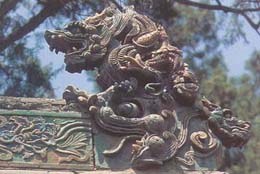
On the roofs, there is a special kind of ornaments called wenshou or
zoomorphic ornaments, namely, a phoenix-riding god followed by a string of
zoomorphic figures, some of which are on the main ridges, with others on the
sloping, branch ridges, and eaves. Lovely and beautiful, these ornaments are
seen as a sparking point of the ancient architectural decoration. Inside the
architectural circles, these ornaments are called "Zou Tou Wu Lu
(having no way out)," as these little animals are at the very end of the
ridges or eaves.
Exquisitely made and orderly arranged, what were these zoomorphic ornaments
used for, apart from serving decorative purpose? Let's take a closer look.
 Historical and Cultural Origins Historical and Cultural Origins
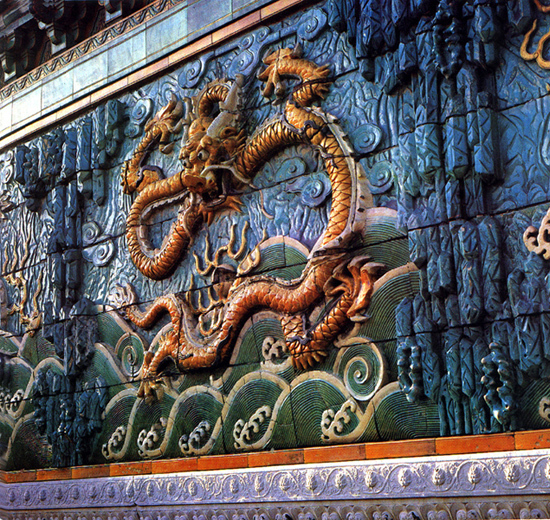
 The zoomorphic ornaments have their origin in the Chinese dragon
culture, an important part of the brilliant Chinese culture. Energetic,
decisive, optimistic, intelligent, and ambitious, the Chinese dragon is often
seen as the symbol of the Chinese nation, and Chinese people everywhere proudly
claim themselves as "Descendants of the Dragon." Ancient Chinese people adored
the dragon, and hoped it might help them get rid of the ill fortune and natural
disasters in their lives. The zoomorphic ornaments have their origin in the Chinese dragon
culture, an important part of the brilliant Chinese culture. Energetic,
decisive, optimistic, intelligent, and ambitious, the Chinese dragon is often
seen as the symbol of the Chinese nation, and Chinese people everywhere proudly
claim themselves as "Descendants of the Dragon." Ancient Chinese people adored
the dragon, and hoped it might help them get rid of the ill fortune and natural
disasters in their lives.
Over time, the dragon culture evolved from purely conceptual ideas, such as
descendants of the dragon and dragon adoration, to concrete things in people's
daily life, including dragon-decorated clothes (such as dragon robes for the
emperors), utensils, and ornaments and talismans on buildings. The dragon
culture appeared wherever Chinese culture went, and was prominent in ancient
architectures, especially in decorative carvings.
|
|




 E-Mail
This Article
E-Mail
This Article  Print
Friendly Format
Print
Friendly Format