 |
 |
 |
 |
 |
 |
|
|
|
|
|
|
| Art Q&A > Music |
|
|
||||||
 E-Mail
This Article E-Mail
This Article  Print
Friendly Format Print
Friendly Format |
||||||
|
Yiyang tune - A dying art?
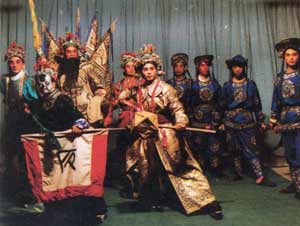
The Yiyang tune was born at the end of the Yuan Dynasty (1271-1368) and the beginning of the Ming Dynasty (1368-1644) in Yiyang County, Jiangxi Province. As early as the Yongle reign (1403-1424) of the Ming Dynasty, the Yiyang tune was not only prevalent in Jiangxi Province, but also in Anhui, Fujian, Yunnan and Guizhou provinces. In fact, the tune first emerged by combining operas around the Yiyang region with its local dialects. Reputed as the overlord of Chinese opera, together with the Kunshan tune, the Yiyang tune exerted great influence on the 44 types of Chinese opera, including Peking Opera, Sichuan Opera, Hunan Opera, Qinqiang Opera, etc. The Yiyang tune is therefore regarded as the absolute forefather of Chinese high-pitched operas. As a highly refined opera, the Kunshan tune was favored by scholars, bureaucrats and literati, but only captured the attention of the Wuzhong region in the Ming Dynasty; the Yiyang tune, on the other hand, which was almost completely neglected by scholars, became a folk art adored by ordinary people.
During a Yiyang tune performance, an actor performs a solo on stage, with others joining in offstage to accompanying percussion instruments. Artists of the Yiyang tune have created "gun diao" -- a type of spoken word, where each sentence of the same length is added after the long or short aria. Gun diao can be subcategorized into "gun bai", where a paragraph is recited between two arias, and "gun chang ", where a paragraph is sung between two arias. The Yiyang tune, which does not have musical scores, is performed according to the local folk tune patterns. Free from the restriction of musical scores and embracing local dialects, Yiyang has a competitive edge over the refined Kunshan tune.
|
||||||
 Features of the Yiyang tune
 |