 |
 |
 |
 |
 |
 |
|
|
|
|
|
|
| Art Q&A > Architecture |
|
||
 E-Mail
This Article E-Mail
This Article  Print
Friendly Format Print
Friendly Format |
||
|
Screen Walls: More Than Meets the Eye
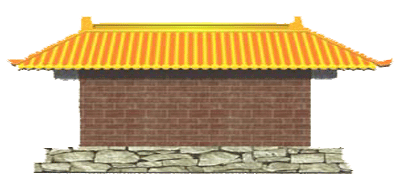
The screen wall, called yingbi or zhaobi in Chinese, can be made of any kind of material -- brick, wood, stone or glazed tile. The yingbi dates back at least to the Western Zhou Dynasty (11th century BC-771BC). Archaeologists have discovered the remains of a screen wall in recent years in tombs from the period in Shaanxi Province. The wall measures 240 cm in length and is 20 cm high. This is the earliest known wall of its kind in China at the time of writing. In ancient times, the yingbi was a symbol of rank. According to the
Western Zhou system of rites, only royal palaces, noblemen's mansions and
religious temples had screen walls. Apart from keeping passersby from peeping
into the courtyard, the screen wall was also used by a visitor to tidy up his
dress before going in. It was not until much later that private houses (mainly
bungalow quadrangles in northern parts of the country) began to have screen
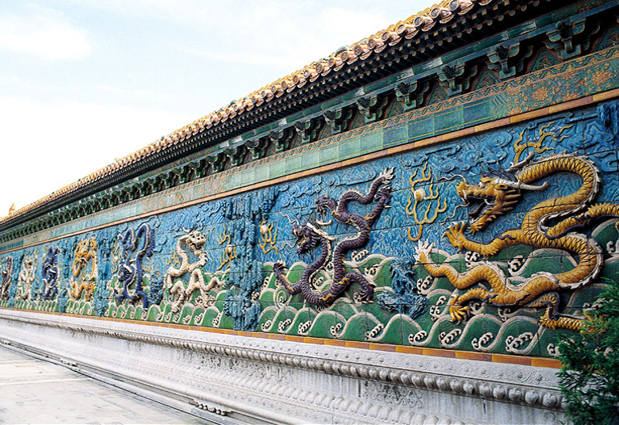
walls. The most exquisite of all ancient screen walls are the three "nine-dragon walls" constructed of glazed colored tiles. The largest of these, 45.5m by 8m by 2.02m, is now in Datong, Shanxi Province. It originally stood in front of the princely mansion of the 13th son of Zhu Yuanzhang, the first emperor of the Ming Dynasty (1368-1644). Sculpted in seven different colors are nine dragons in the clouds. The most splendid of the three is the one belonging to a palace of the Ming Dynasty, which now stands north of the lake in Beijing's Beihai Park. It is a mosaic of glazed colored tiles displaying a relief of nine coiled dragons on each side. One can count the 635 smaller dragons along the ridges and roof tiles of the wall. The third wall stands opposite of the Huangjimen Gate in the Forbidden City; it is very well known to sightseers. All of the three walls were built during the Ming Dynasty and used to stand in front of the entrance to a courtyard - becoming an integral part of the architectural complex and adding to the magnificence of the buildings. Apart from these walls, there are also screen walls with one, three or five dragons in different parts of the country. There are screen walls located in each of the side palace courtyards at the Forbidden City. Whether made of wood, carved from marble or glazed tile, they are all fine works featuring designs that symbolize good luck. Several carved in brick or color-painted screen walls found in China's eastern provinces bear images of the strange animal called tan. According to local beliefs, this animal was so greedy that it wanted to devour the rising sun over the sea, meeting its own death by drowning. The picture serves as a reminder that greed leads to self-destruction. In the vicinity of the Five Dragon Pavilion in Beihai Park, there is a so-called "iron screen wall" -- a relic from the Yuan Dynasty of the 13th century. At first glance, it appears to have been cast in iron but it is actually a piece of volcanic rock. Carved on it in a vivid style are lions playing with a ball on one side and, on the other, a legendary unicorn. The wall is noted for its antiquity and simplicity. |
||
 |