 |
 |
 |
 |
 |
 |
|
|
|
|
|
|
| Art Q&A > Painting |
|
|
||||||
 E-Mail
This Article E-Mail
This Article  Print
Friendly Format Print
Friendly Format |
||||||
|
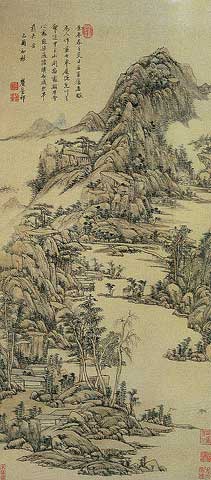
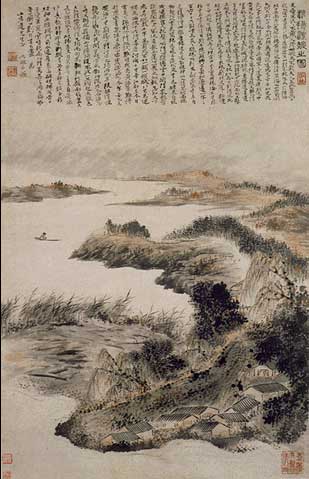
Four Wangs and Four Monk Painters
The Four Wangs paid little attention to the content of their paintings, but attached great importance to learning from and imitating traditional Chinese painting skills. Though they were skillful in brushstroke techniques and accomplished much artistically, their art works were too detached from life. Among the four, Wang Yuanqi was the youngest but achieved the highest. Wang Yuanqi was appreciated by the emperor, so he had a lot of disciples and formed an independent school, Loudong School named after Taicang. Paintings of this school played a dominant role at that time. The design, layout and use of color reached a high level; however, serving the need of the governors, they had little creative ideas, which in compliance with the government of the Qing Dynasty.
Shi Tao was the most creative painter in the early stage of the Qing Dynasty, with the bold use of colors and ink. Influenced by Xu Wei and Chen Chun, Zhu Da was famous for his paintings of flowers and birds, showing his inner feelings by painting. Shi Tao, though followed the style of Huang Gongwang and Wang Meng, formed his unique style of painting with majestic characteristics. |
||||||
All rights reserved. Reproduction of text for non-commercial purposes is permitted provided that both the source and author are acknowledged and a notifying email is sent to us. |
||||||
 |