 |
 |
 |
 |
 |
 |
|
|
|
|
|
|
| Art Q&A > Architecture |
|
|
||||||
 E-Mail
This Article E-Mail
This Article  Print
Friendly Format Print
Friendly Format |
||||||
|
Lamaist Pagoda
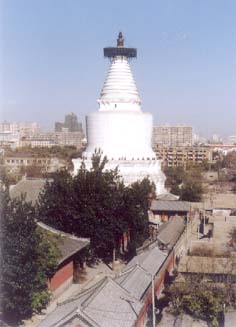
The bottle-type pagodas mostly look like bottles, and are said to be modeled on a clean bottle for storing water, but, in fact, originated from India's stupa. The extant earliest Lamaist pagoda of China is the White Pagoda of Miaoying Monastery in the capital of the Yuan Dynasty (1271-1368), housed in the Miaoying Monastery (present-day White Pagoda Monastery in Fuchengmen of Beijing). It is the most outstanding representative of the bottle-type Lamaist pagodas.
Built in the 8th year (1271) in the reign of Yuan Emperor Shizu, this bottle-shaped pagoda was the work of Nepalese artisan Ahnigethe Miaoying. This magnificent monastery is 51 meters high and is divided into three sections. The lower section is a three-storied pedestal, while the planes are all polygonal angle cross. The middle section is the pagoda body -- round, solid, thick and strong. Below the pagoda body there is a very big covered lotus seating, and several layer lines. At first, the pagoda body was carved with such unique Tibetan Buddhist pictures as single pestles, pearls, lotus, and cross pestles, and wrapped in pearl nets and tassels. But, none of these now exist.
On the upper section is seated the polygonal angle cross Sumeru pedestal. Further up is a huge, solid, 13-layer wheel, with each layer becoming evidently smaller than the other, called "13 heavens", which Supports the pagoda roof. The pagoda roof is placed on a huge bronze treasure cover 9.9 meters in diameter arranged with a 5-meter high bronze Lamaist Pagoda. Pierced copper plates and copper bells hang down around the treasure cover.
The White Pagoda is all laid up with stones except for the pagoda top which is built with copper. Its exterior is stuck with bricks and plastered with lime. It is as bright and clean as jade, and therefore is called a "Jade pagoda". The copper pagoda roof is of golden color; the contrast between golden and white creates a noble, holy and clean atmosphere. The whole pagoda is even and sturdy, vigorous and broad in momentum and is well-coordinated with the boldness of the capital of the Yuan Dynasty.
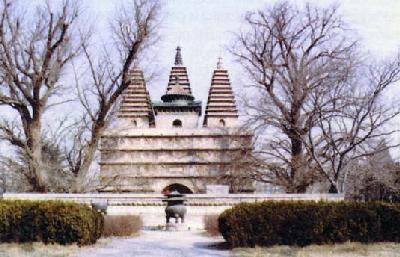
Extant important diamond pagodas include Beijing's Stupa of the Five-Division Vajnadhatu (Zhenjue Monastery, built in 1473), Biyun Monastery, Qing Jinghua Chengta of Xi Huang Si, and the Cideng Monastery in Hohhot. In front of the Miaozhan Monastery of Kunming Guandu, there is one such monastery, called Miaoying Lanruo Pagoda.
Existing well-known cross-street pagodas include the Yuntai in northwest Beijing's Juyongguan Pass and the Yuntai Shanta in Zhenjiang of Jiangsu Province, both built during the Yuan Dynasty. |
||||||
All rights reserved. Reproduction of text for non-commercial purposes is permitted provided that both the source and author are acknowledged and a notifying email is sent to us. |
||||||
 |