 |
 |
 |
 |
 |
 |
|
|
|
|
|
|
| Art Q&A > Architecture |
|
|
||||||
 E-Mail
This Article E-Mail
This Article  Print
Friendly Format Print
Friendly Format |
||||||
|
Tibetan Buddhist Monasteries
Tibetan-type Lama temples can also be divided into those built on level ground and those set up at the foot of mountains, with the latter accounting for the greater part. Flatland temples are often of a semi-regulated and symmetrical form, with the image of the main big hall as the composition center being most outstanding. A free-style layout is used for temples at the foot of mountain areas, which lacks both an overall axis and a pre-determined plan, although they still follow some rules for arrangement.
The gate of the monastery faces west and is close to Barkor Street which encircles Zuglakang Monastery. Everyday, believers make a clockwise circular perambulation to show respect for the Buddha.
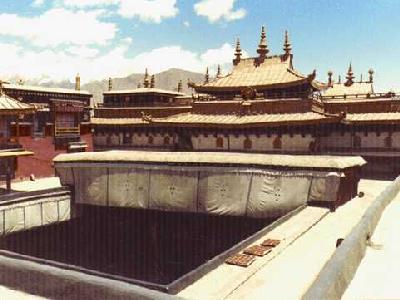
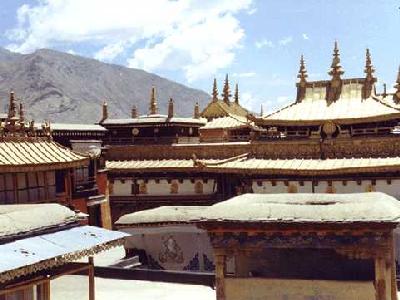
Walking through a doorway with a porch, across a thousand-Buddha verandah, one finds the Johkang Hall, the main hall of the Zuglakang Monastery. Johkang Hall is in a plane, square shape, with four layers on all sides, partitioned into small Buddhist halls. The Buddhist hall on the axis houses the statue of Sakyamuni brought by Princess Wencheng of the Tang Dynasty (618-907), who was married to Tibet for peace mission. In another Buddhist hall, there are the statues of Srong-brtsan-sgam-po, Princess Wencheng and Princess Chizun from Nepal. The center is a large space leading up to three floors with a flat top. There is a gilded copper roof on the middle of each of the four sides of the fourth floor. Its figure is modeled after the structure of the Han nationality, and there is a truncated turret on each of the four corners.
The gate of the Zuglakang Monastery, the Thousand-Buddha Verandah and the Johkang Hall, plus the small encircled yard, seem to play the role of a screen wall, and together constitute an axial symmetric space series. The encircled yard and the concave temple gate form a small square in front of the monastery, which is the starting-point of the series. The Thousand-Buddha Verandah is wide and spacious, while the Johkang Hall is closed and inhibited, providing a stark contrast. The golden roof of the Johkang Hall is full of distinguishing features: short eaves are arranged surrounding the top of the entire square outer wall to bind up the whole hall, and extend outward from the four golden-top halls that create a multi-eaved effect.
Outside the front gate of the monastery is a small-encircled yard, inside which there is a willow tree said to have been planted by Princess Wencheng.
The Zuglakang Monastery is a gem in the Tibetan architectural development. |
||||||
All rights reserved. Reproduction of text for non-commercial purposes is permitted provided that both the source and author are acknowledged and a notifying email is sent to us. |
||||||
 |