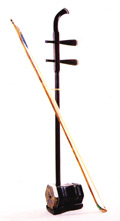
Bowed-stringed instruments became popular in China during the Sung Dynasty (960 to 1279 AD). The instruments are played using a bow made of horse hair to vibrate the strings. They generally have a soft, elegant tone, which is often used to produce a feeling of weeping or complaining. The most popular bowed strings include Erhu, Gaohu, Zhonghu, Dihu, Gehu and Di Gehu.
For the past thousand years, string instruments have been well developed in China. Old instruments were improvised upon to give birth to newer and better instruments. New and difficult performing techniques were also developed over the years to increase the capability of the string to express its music vividly. Gaohu and Erhu are the outstanding ones among the instruments and are capable of performing in solos and concertos.
In a modern Chinese Orchestra, the strings occupy a position comparable in importance to the violin in a western orchestra.
Erhu is also known as Huqin, the full name for Hu. Its early ancestor was known as Xiqin (string instrument of a Mongolian tribe called Xi) in the tenth century. The instrument has two strings and is played with the bow clasped between them. Its two strings are generally tuned a fifth apart and its range can reach 3 or 4 octaves. The sound box is covered by snake skin which gives the instrument its distinctive mellow and bright tone.
Under the influence of the regularly trained musician Liu Tianhua (1895-1932) and the local minstrel Hua Yanjun (known as the blind Man Ah Bing, 1893-1950) during the 1920's, the Erhu developed into a solo instrument. Today the Erhu is one of the most widely used bowed instruments in China, It is appropriate both for deep tragedy and for the momentum of an avalanche. Besides, it also assumes a central position in the modern Chinese orchestra, as well as in the accompaniment of singing and dancing.
Playing techniques are rich for both hands, including, harmonic tones, trills, glissandos, pizzicatos for the left hand and legatos, detaches, martellatos, saltandos, tremolos, flying staccatos for the right hand.